
Silicone Heat Resistance and Temperature Range, Explained
Standard silicone operates continuously up to 200°C (392°F). It can tolerate short-term exposure up to around 230°C without permanent damage. Above 300°C (572°F), thermal decomposition begins. It does not melt, it degrades.
That wide range comes from the material's chemistry, but the numbers above are what most part designers need first.
What silicone can withstand at a glance
| Condition | Temperature |
|---|---|
| Continuous operating (standard grades) | -50°C to 200°C |
| Short-term peak | up to ~230°C |
| Decomposition onset | above 300°C |
| Continuous operating (DR2350A conductive grade) | -50°C to 210°C |
If your application sits above 200°C continuously, confirm the grade with your manufacturer before finalizing the design.
Why silicone handles heat better than most rubbers
The backbone of silicone is a chain of silicon and oxygen atoms (Si-O). That bond requires about 450 kJ/mol to break, significantly more than the carbon-carbon bonds (around 350 kJ/mol) that form the backbone of most organic rubbers. Higher bond energy means higher resistance to thermal breakdown.
Silicone also has a very low glass transition temperature, around -50°C to -125°C depending on the formulation. Below that point the material stiffens; above it, the chains stay mobile and flexible. Because that threshold is so low, silicone remains rubbery and functional across the full range from cold storage temperatures up to near its decomposition point.
What happens above 300°C
Silicone does not burn the way organic polymers do. When it decomposes at high temperatures, the primary byproducts are silica (SiO₂), carbon dioxide, and water. Compared to many synthetic rubbers, particularly those containing halogens, these are relatively low-hazard decomposition products.
For applications with documented flammability or toxic gas emission requirements, the relevant tests are UL94 (flame rating) and SMP-800C (toxic gas). Our DR2350A compound passes both: UL94 V-0 and SMP-800C PASS. We can provide the material cert on request.
Does silicone expand with heat?
Yes. Silicone has a high coefficient of thermal expansion, around 200 to 300 ppm/°C for standard PDMS-based compounds. That is significantly higher than metals or ceramics.
In practice this matters less than it sounds. Because silicone stays flexible across its operating range, it accommodates that expansion and contraction without cracking or losing its seal. For gaskets and seals that cycle through temperature changes, this is an advantage over rigid materials that fatigue over time.
If your assembly has tight dimensional constraints at both ends of the temperature range, raise that during DFM review. We check for this on every new part.
Is silicone a good heat insulator?
Standard silicone is a poor conductor of heat, which makes it a good thermal insulator. Heat transfers slowly through the material, which is useful for protective sleeves, insulation pads, and covers on hot components.
When the application requires heat to move through the part rather than be blocked, such as thermal interface pads and heat dissipation components, standard silicone is not the right choice. Thermally conductive grades are formulated with fillers that raise conductivity significantly. Our DR2350A grade reaches 1.3 W/m·K, tested per ASTM D5470.
Grade in use: thermally conductive silicone (DR2350A)
DR2350A is a heat-cure mixed silicone compound we use for parts that need both thermal conductivity and flame resistance. It runs on standard compression molding, calendering, and extrusion processes. No secondary cure required.
Key properties (ASTM-tested):
| Property | Value | Standard |
|---|---|---|
| Thermal conductivity | 1.3 W/m·K | ASTM D5470 |
| Operating temperature | -50°C to 210°C | n/a |
| Hardness | 52 Shore A | ASTM D2240 |
| Tensile strength | 2.25 MPa | ASTM D412 |
| Elongation at break | 169% | ASTM D412 |
| Flame rating | UL94 V-0 | UL94 |
| Toxic gas emission | Pass | SMP-800C |
Certifications: RoHS, SGS halogen-free, REACH, UL94 V-0.
52 Shore A is firm but still compressible, similar to a dense eraser. It holds shape under load without being rigid.
One thing worth discussing at the quoting stage: the thermally conductive filler shifts the cured color toward gray. If your part has a Pantone or RAL color requirement, flag it early so we can assess whether a different formulation is more suitable. It is easier to resolve before the mold is built than after.
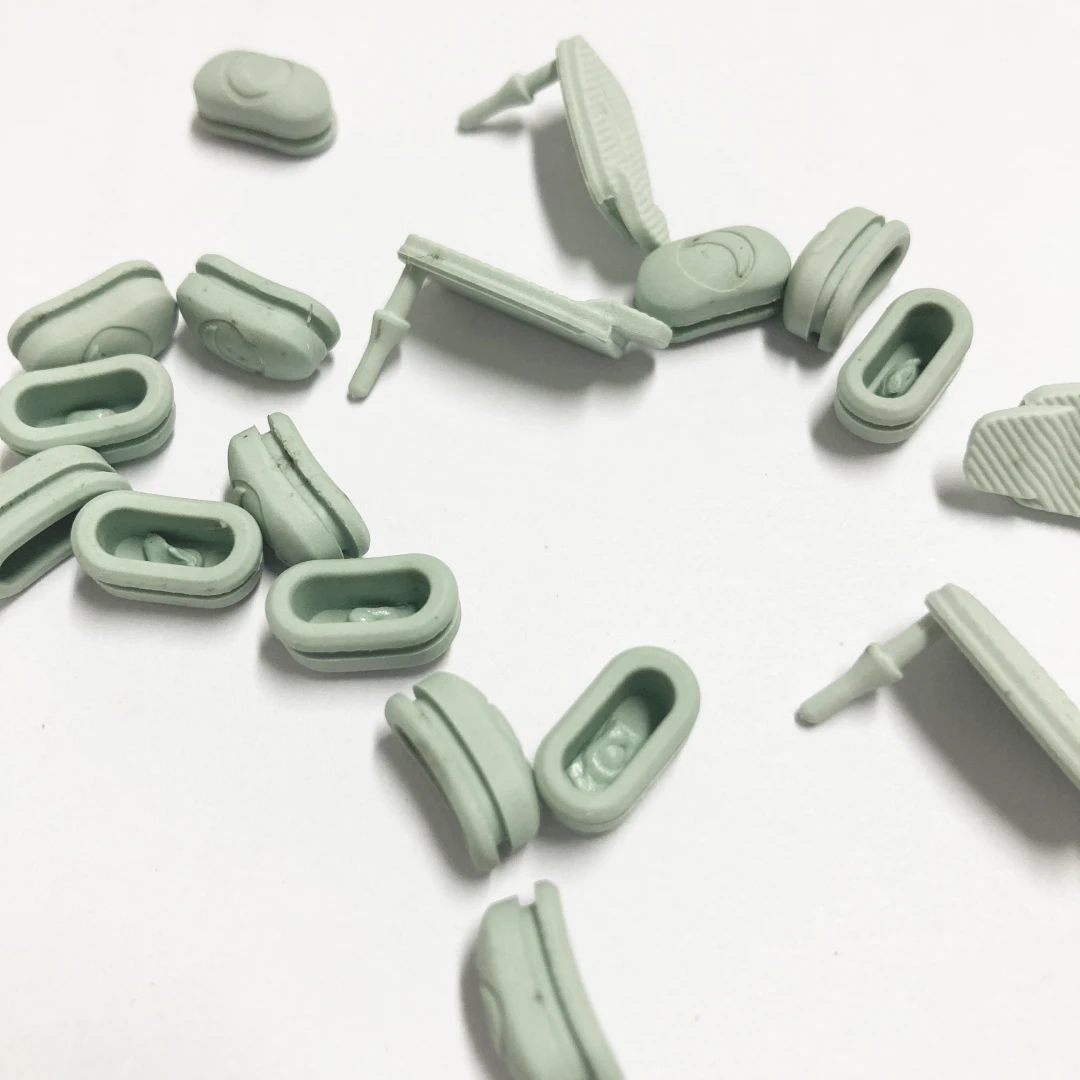
Material datasheet and batch cert available on request.
Where high-temperature silicone gets specified
Most of the parts we make in this category are industrial components: gaskets, seals, strips, pads, and covers used in equipment that runs hot or cycles through wide temperature ranges. The common thread is a requirement for a part that holds its properties across that range without hardening, cracking, or off-gassing.
If your application has both a thermal spec and a flammability requirement, those two constraints together narrow the material options quickly. We run a DFM review on every new project. Send us your design and we will confirm the right grade before we quote.
Dabojin has made custom silicone parts since 2005. We hold ISO 9001, ISO 45001, and ISO 14001 certifications. Material traceability and batch records are standard on every order.
Frequently asked questions
What temperature does silicone melt at?
Silicone does not have a melting point. It is an amorphous polymer and does not transition from solid to liquid the way crystalline materials do. Instead, it degrades above 300°C (572°F), breaking down into silica, carbon dioxide, and water.
Does silicone melt when heated?
No. Silicone has no melting point, it is an amorphous polymer, not a crystalline one. Standard grades stay flexible and functional up to 200°C continuous, tolerate short peaks to around 230°C, and begin decomposing above 300°C rather than turning liquid.
Does silicone burn?
No. Silicone does not ignite and burn the way organic rubbers and plastics do. Above 300°C it decomposes rather than combusts, breaking down into silica, carbon dioxide, and water. Our DR2350A grade is rated UL94 V-0, the standard flame test for self-extinguishing materials.
How much heat can silicone handle?
Standard silicone grades operate continuously up to 200°C (392°F) and can tolerate short-term exposure up to around 230°C. Thermally conductive grades like DR2350A are rated to 210°C continuous.
Does silicone expand with heat?
Yes. Silicone has a high coefficient of thermal expansion, around 200 to 300 ppm/°C. It expands noticeably with heat, but because it stays flexible it does not crack or fail. For seals and gaskets that cycle through temperature changes, this flexibility is an advantage.
Is silicone a good heat insulator?
Standard silicone is a thermal insulator and heat transfers through it slowly. If your application requires heat to move through the part rather than be blocked, a thermally conductive grade is needed.
Does silicone release toxins when heated?
Below its decomposition temperature, silicone does not off-gas significantly. Above 300°C, decomposition products are primarily silica and carbon dioxide, which are less hazardous than most synthetic rubbers. For applications with formal requirements, ask for a material cert showing SMP-800C toxic gas emission results.
What is the difference between silicone and rubber at high temperatures?
Most organic rubbers rely on carbon-carbon bonds, which break down at lower temperatures than the silicon-oxygen bonds in silicone. Standard rubber compounds typically fail above 100°C to 120°C. Silicone maintains its properties up to 200°C continuously.
Resource Library
Explore additional technical resources:
- Silicone 101: Chemistry and Composition
- Material Library: 17 Silicone Grades and Their Uses
- Compare Silicone and Plastic by Breaking Myths and Knowing the Facts
- Discover the Pros and Cons of Antibacterial Silicone and When to Use It
- See How We Make Silicone Clean, Pure, and Free of Dust
- Rubber Material Selection Guide: 32 Compounds by Requirement
- Silicone Hardness Chart: Shore A Scale Explained
- Transparent Silicone Parts: Achieving Balance
- MOQ Explained: What It Means for Your Quote
- Design Guide: From Durometer to DFM