
ISO & FDA Compliance in Our Silicone Manufacturing
At Dabojin, quality, safety, and sustainability are built into every stage of our silicone product manufacturing, from raw material selection to final inspection. That commitment is backed by independently audited management systems and food- and medical-grade material compliance, verified through advanced laboratory testing.
Our Certifications & Compliance at a Glance
- ISO 9001:2015 - Quality management
- ISO 45001:2018 - Occupational health and safety
- ISO 14001:2015 - Environmental management
- FDA-compliant & food-grade silicone - 21 CFR 177.2600 (and USP Class VI / ISO 10993 for medical-grade material, where specified)
ISO 9001:2015 - Quality Management
Consistent, Repeatable Silicone Manufacturing
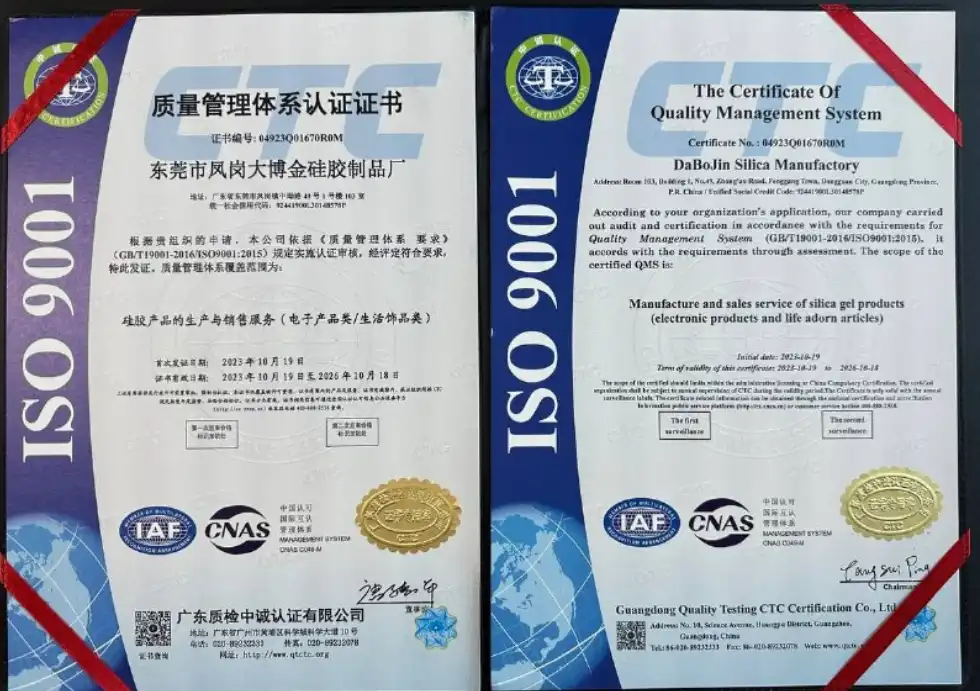
ISO 9001 is the world’s most widely recognized quality management standard. Certification means an accredited third party has audited how we run the business, not just the products we ship, against a documented, repeatable system. For your project, that means predictable output batch after batch, traceability from incoming material to finished part, and a defined process for handling any non-conformance.
Our ISO 9001 system governs:
- Process control and traceability: documented procedures and batch records so every order can be traced back through production.
- Corrective and preventive action: identifying the root cause of a defect and stopping it recurring, rather than just scrapping the part.
- Continual improvement: regular internal audits and management review to tighten tolerances and reduce variation over time.
- Customer focus: requirements captured up front and verified at inspection, so what you specified is what you receive.
ISO 45001:2018 - Occupational Health & Safety
A Safe, Stable Workforce Behind Your Order
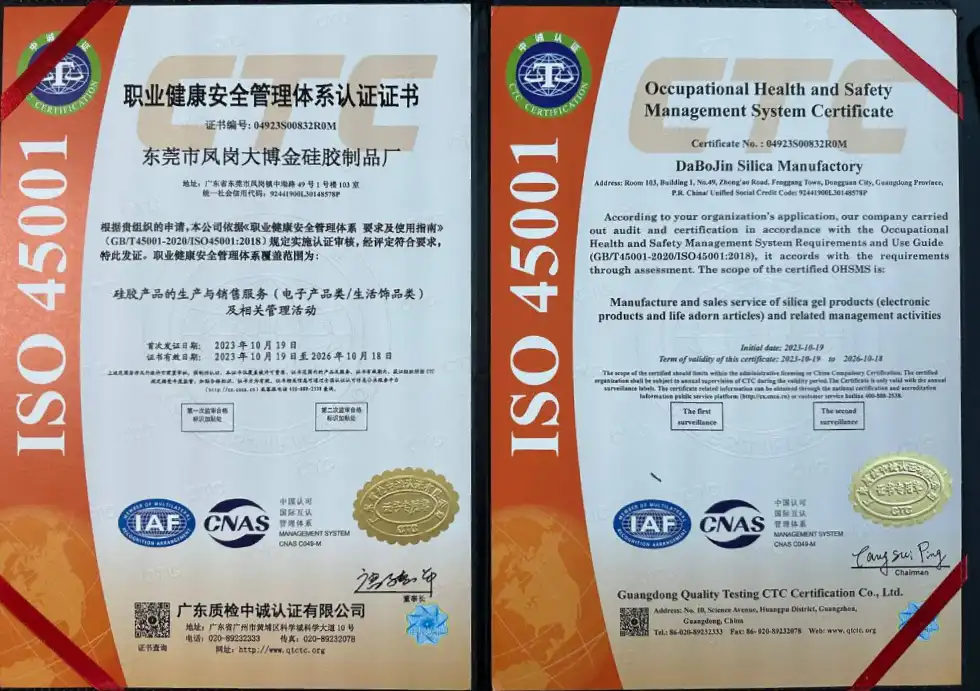
ISO 45001 is the international standard for occupational health and safety management systems, and it replaced the older OHSAS 18001 framework. Beyond protecting our team, a certified safety system signals operational maturity: well-run facilities with low incident rates hold schedules, retain skilled operators, and avoid the disruptions that lead to missed delivery dates.
Our ISO 45001 system focuses on:
- Hazard identification and risk assessment: systematically finding and controlling risks on the production floor before they cause harm.
- Worker participation: the people doing the work help shape the safety controls, a core requirement of the standard.
- Emergency preparedness: defined response procedures that keep both people and production protected.
- Ongoing monitoring: incidents are tracked, investigated, and used to improve controls.
ISO 14001:2015 - Environmental Management
Lower-Impact, More Sustainable Production
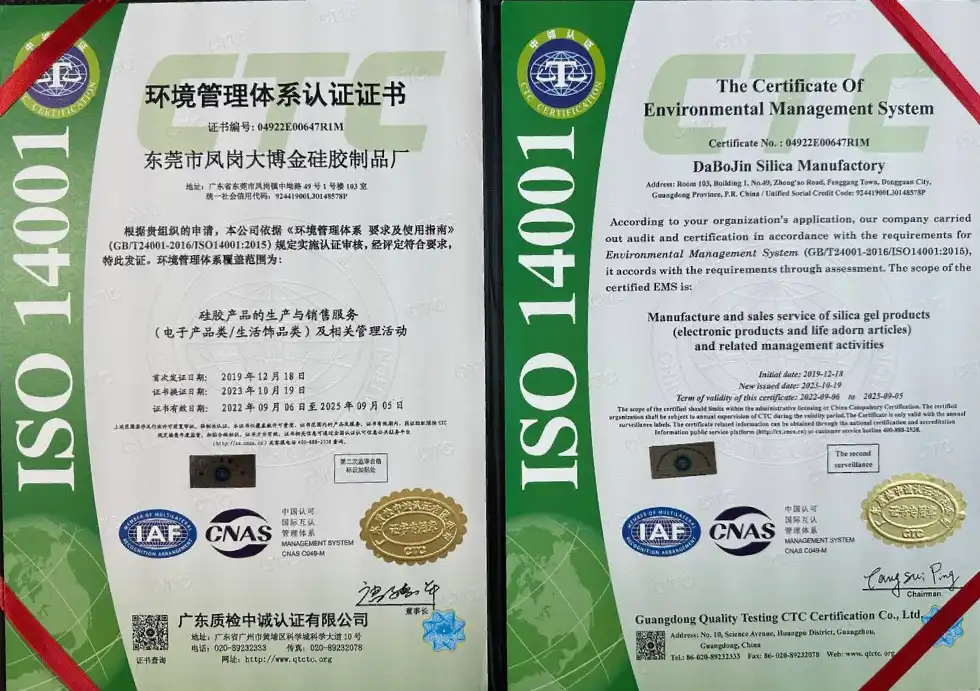
ISO 14001 sets the requirements for an environmental management system (EMS). Certification means we identify the environmental aspects of our operations (energy, waste, emissions, and material use) and manage them against measurable objectives, with regulatory compliance built in. For brands with sustainability commitments of their own, a certified EMS in the supply chain is increasingly something buyers ask to see documented.
Our ISO 14001 system covers:
- Legal and regulatory compliance: a documented obligation to meet applicable environmental regulations.
- Waste and resource management: reducing scrap, reusing where possible, and controlling disposal.
- Measurable objectives: environmental targets that are tracked and reviewed, not just stated.
- Lifecycle thinking: considering environmental impact across material selection and production.
FDA-Compliant & Food-Grade Silicone
What “Food-Safe” Actually Means
An important clarification, because the industry uses the phrase loosely: the FDA does not issue a blanket “approval” for silicone or for silicone manufacturers. What exists is compliance with a specific regulation. For silicone in repeated food contact, that regulation is 21 CFR 177.2600: “Rubber articles intended for repeated use.” A compound is considered FDA-compliant when it is formulated from permitted ingredients and passes the extractables testing the regulation prescribes (extraction in both water and n-hexane under defined time and temperature conditions, kept below the allowable limits).
Where we support food-contact requirements, we work with silicone that meets:
- FDA 21 CFR 177.2600: repeated food-contact compliance, typically using high-purity, platinum-cured silicone.
- Additional voluntary standards on request: for example NSF/ANSI 51 (food equipment), or, for products sold into the EU, Framework Regulation (EC) 1935/2004 and related national measures.
For medical and healthcare applications, food-grade compliance alone is not sufficient. Those products are evaluated against USP Class VI and ISO 10993 biocompatibility requirements, which test the material for contact with the body rather than with food. See our guides on biocompatibility testing and silicone testing for medical devices.
Compliance You Can Verify
Certification claims are only as good as the evidence behind them. Our material safety is confirmed by accredited analytical testing: for example, ICP-OES screening returns non-detect results for heavy metals such as lead, cadmium, mercury, and hexavalent chromium, and GC-MS screening returns non-detect results for regulated phthalates. See the full methods and sample results on our Advanced Testing Methods page, which also covers our approach to RoHS, California Proposition 65, and EN 71-3 compliance.
Note: we state the specific grade (food-grade vs. medical-grade) that applies to your product and provide the corresponding material declaration and test documentation on request.
What Our Certifications Mean for You
Certifications are only useful if they change something for the customer. Ours are meant to give you three things: consistency (ISO 9001: the part you approve is the part you keep receiving), reliability (ISO 45001 and ISO 14001: a stable, well-run operation that holds schedule), and documented material safety (FDA / food- and medical-grade compliance, backed by declarations and test reports). If your project needs a specific certificate or compliance document up front, we can share it during quoting.